The biggest AI risk in your organization may not be the AI you know about it. It’s the AI you can’t see.
Organizations spent years learning how to manage Shadow IT.
Unsanctioned applications. Unknown cloud services. Departments adopting technology faster than governance teams could keep up.
Most organizations eventually learned an important lesson:
- You cannot manage what you cannot see.
- Now the same challenge is emerging again.
- Only this time, it is moving much faster.
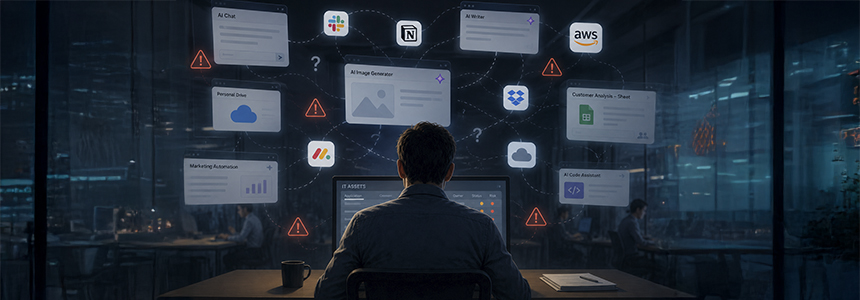
AI tools and agents are finding their way into everyday business operations. Marketing teams use them to generate content. Sales teams use them to research prospects. HR teams use them to screen resumes. Developers use them to write code. Operations teams use them to automate repetitive tasks.
In many cases, these tools arrive long before governance, security, or compliance teams know they exist.
That is what makes Shadow AI different.
Unlike traditional software, AI systems can access information, make decisions, trigger actions, and interact with other applications. They do not simply store data. They influence business processes.
And many organizations have little visibility into where these AI systems are being used, what data they are accessing, or what decisions they are helping make.
The assumption is often that AI adoption is still in its early stages. The reality is very different.
Employees do not wait for formal approval cycles when a tool can save hours of work. Teams experiment. Departments optimize. New workflows emerge. Before long, AI becomes embedded into day-to-day operations without ever appearing on an official technology roadmap. The result is a growing blind spot.
Sensitive information may be shared with AI systems that were never reviewed. Business decisions may be influenced by models that nobody is actively monitoring. Automated actions may occur without clear ownership or accountability.
Most organizations are not intentionally creating this risk. They simply do not have a way to see it.
The challenge is no longer deciding whether AI will be adopted. That decision has already been made.
The real challenge is understanding where AI exists, who is using it, what data it can access, and how its activities align with governance requirements.
Organizations that solve this problem early will be able to embrace AI with confidence. On the other hand, organizations that ignore it may eventually discover that their biggest AI risk was never the technology itself.
It was the lack of visibility around it.
Because the future of AI adoption will not be determined only by innovation.
It will also be determined by governance.