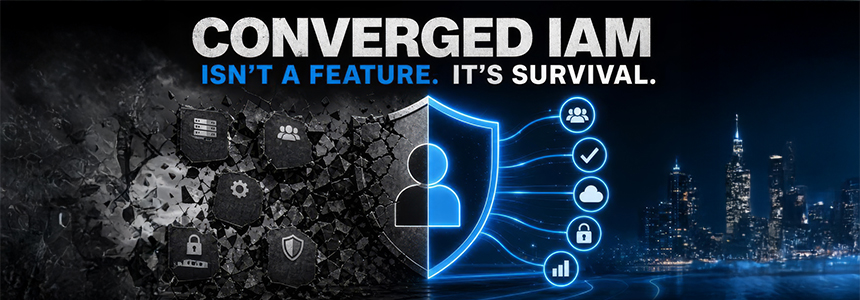
Every vendor claims “converged IAM.”
Unified platform. Single pane of glass. Integrated governance.
Then you ask: “Can it govern AI agents?”
Silence.
Because converged IAM isn’t about putting old capabilities in one interface.
It’s about governing identities that didn’t exist when IAM was invented.
The Old Definition of Converged IAM
Traditional convergence:
- IGA + PAM in one platform
- Access governance + privilege management
- User lifecycle + access certification
- Joiner-mover-leaver + entitlement reviews
Benefit: Fewer vendors. Simpler procurement. One throat to choke.
Problem solved: Integration overhead between IGA and PAM.
Problem not solved: 97% of your identities still ungoverned.
The New Definition of Converged IAM
Modern convergence:
- Human + Machine + AI identities
- Access + Behavior + Risk
- Prevention + Detection + Response
- Cloud + On-prem + SaaS
Benefit: Actually govern all entities making decisions in your environment.
Problem solved: The identity explosion that broke traditional IAM.
Why This Distinction Matters
Old converged IAM governs:
- 50,000 employees
- 10,000 contractors
- 5,000 partners
- Total: 65,000 identities (mostly human)
New converged IAM governs:
- 50,000 employees
- 10,000 contractors
- 5,000 partners
- 340,000 service accounts
- 520,000 devices
- 73,000 AI agents
- 220,000 customers
- Total: 1,218,000 identities (95% non-human)
Your “converged” IAM platform handles the 65,000.
Who governs the other 1,153,000?
The DPDPA Convergence Requirement
Under DPDPA, when data subject requests:
- “What data do you have about me?”
- “Who accessed my data in the last year?”
- “Delete all my personal data.”
Your answer needs to cover:
- Human users who accessed their data (IAM sees this)
- Service accounts that processed their data (IAM doesn’t see this)
- AI agents that made decisions about their data (IAM doesn’t see this)
- Third-party systems that received their data (IAM doesn’t see this)
Traditional converged IAM gives you 5% of the answer.
DPDPA wants 100%.
The EU AI Act Convergence Requirement
Under EU AI Act, for high-risk AI systems:
- “Show us human oversight documentation”
- “Demonstrate access controls for AI agents”
- “Prove audit trail for automated decisions”
You need convergence between:
- IAM (who can access the AI system)
- AI governance (what the AI agent does)
- Risk management (how decisions are controlled)
Three separate systems = three separate compliance gaps.
What Real Convergence Looks Like
Not: IGA + PAM in one UI
But: Identity + Risk + Behavior in one enforcement model
Example scenario:
AI agent requests access to customer PII.
Traditional converged IAM asks:
- Does this service account have permission? (Yes/No decision)
Real converged IAM asks:
- Does this service account have permission? (Identity)
- Is this access pattern normal for this agent? (Behavior)
- What’s the risk classification of this AI agent? (Risk)
- Is human oversight required for this data access? (Governance)
- Combined decision: Allow with oversight requirement + audit trail
That’s convergence. Not just “two products in one platform.”
The Cross Identity Difference
We built convergence from the ground up:
- Identity Fabric (unified identity model for all entity types)
- Deep converged IAM + CIEM (access + cloud entitlements)
- Risk engine (continuous scoring across all identities)
- AI agent governance (purpose-built for autonomous systems)
Not stitched together. Architected as one system.
Why This Can’t Wait
Your current “converged” IAM:
- Governs 65,000 human identities ✓
- Misses 1,153,000 machine/AI/customer identities ✗
DPDPA doesn’t care about your architecture limitations.
EU AI Act doesn’t accept “we govern humans, not agents.”
Convergence isn’t a product marketing term.
It’s the only way to govern modern enterprise identity reality.
The Question
Your vendor says “converged IAM.”
Ask them: “Can it govern AI agents?”
Their answer tells you if they’re selling old convergence or new.