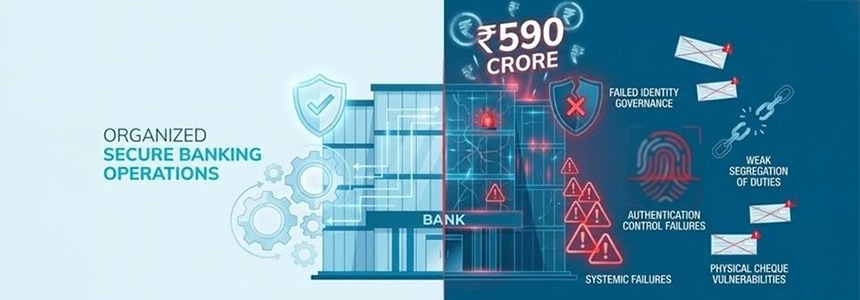
The ₹590 crore fraud at IDFC First Bank’s Chandigarh branch has been characterized by regulators as an “isolated incident” with no systemic risk. While the RBI’s assessment may be correct from a financial stability perspective, from an identity and access management standpoint, this incident reveals systemic vulnerabilities that extend far beyond one bank.
The fraud, allegedly perpetrated through collusion between bank employees and external parties using forged physical cheques on Haryana government accounts, points to fundamental failures in identity governance and access controls that plague the banking sector.
The Real Problem: Privileged Access Without Oversight
According to reports, four bank employees have been suspended in connection with fraudulent transactions confined to specific government-linked accounts. This raises critical questions: How did employees gain the ability to execute ₹590 crore in unauthorized transactions? Why were these activities not flagged in real-time? Where were the access controls?
The answer lies in a pattern I have observed across the banking industry: excessive standing privileges, insufficient segregation of duties, and weak monitoring of privileged user activity.
Bank employees often maintain permanent elevated access to critical systems—the ability to process transactions, modify records, and approve transfers without dynamic verification or real-time risk assessment. This creates the perfect environment for insider fraud, especially when combined with external collusion.
The Forged Cheque Problem Is an Authentication Problem
The use of forged physical cheques highlights another vulnerability: weak authentication mechanisms for high-value transactions. In an era of digital banking, physical cheque processing remains a weak link where identity verification relies on manual inspection rather than automated, cryptographic validation.
Modern identity frameworks should enforce multi-factor authentication and maker-checker workflows for any transaction above materiality thresholds. The fact that ₹590 crore could move through forged instruments suggests these controls either did not exist or were systematically bypassed.
Why This Is Not “Isolated”
While this specific fraud occurred at one branch involving one client group, the underlying identity governance weaknesses exist across Indian banking:
Excessive standing privileges: Bank employees routinely have more access than their job functions require, violating the principle of least privilege.
Manual processes: Physical cheque handling, signature verification, and approval workflows that depend on human judgment rather than automated controls.
Delayed detection: The fraud was discovered only when the Haryana government requested account closure and fund transfer—indicating no real-time anomaly detection was in place.
Weak audit trails: If comprehensive identity and transaction audit logs existed, suspicious patterns should have triggered alerts long before ₹590 crore accumulated.
What Banks Must Implement Immediately
This incident should trigger urgent identity governance reforms across the banking sector:
Just-in-time privileged access: Eliminate standing administrative privileges. Employees should request and receive time-bound elevated access only when needed, with automated expiration.
Continuous transaction monitoring: Implement behavioral analytics that detect anomalous transaction patterns in real-time, not during reconciliation weeks later.
Segregation of duties enforcement: No single employee should be able to initiate, approve, and execute high-value transactions. System-enforced separation prevents collusion.
Comprehensive audit trails: Every access event, every transaction, every authorization decision must be logged immutably with complete identity context for forensic analysis.
Automated reconciliation: Daily automated reconciliation of account balances against transaction logs would have detected discrepancies immediately, not after government departments requested closures.
The Broader Lesson
The RBI is correct that this poses no systemic financial risk—Indian banks are well-capitalized. But there is systemic identity governance risk across the sector.
As banks digitize operations and handle increasing transaction volumes, identity-based fraud will only accelerate. The employees who perpetrated this fraud understood the identity and access control weaknesses they could exploit. External fraudsters are studying the same vulnerabilities.
IDFC First Bank has initiated a forensic audit through KPMG, which will likely recommend enhanced controls. But the entire banking industry should treat this as a wake-up call.
The ₹590 crore loss is significant. The reputational damage—reflected in the 20% stock price crash and Haryana government’s de-empanelment decision—is worse. But the most concerning aspect is that similar vulnerabilities likely exist in branch operations across Indian banking.
Identity governance is not an IT project. It is operational risk management. Until banks treat privileged access, transaction authorization, and identity verification as business-critical controls rather than administrative overhead, incidents like this will recur.
The question is not whether another bank will experience similar fraud. The question is which one, and whether they will detect it before losses reach hundreds of crores.
Ref: Click Here